
How to Build Profitable Pods in Reppo (2026)
I will start with two screenshots.

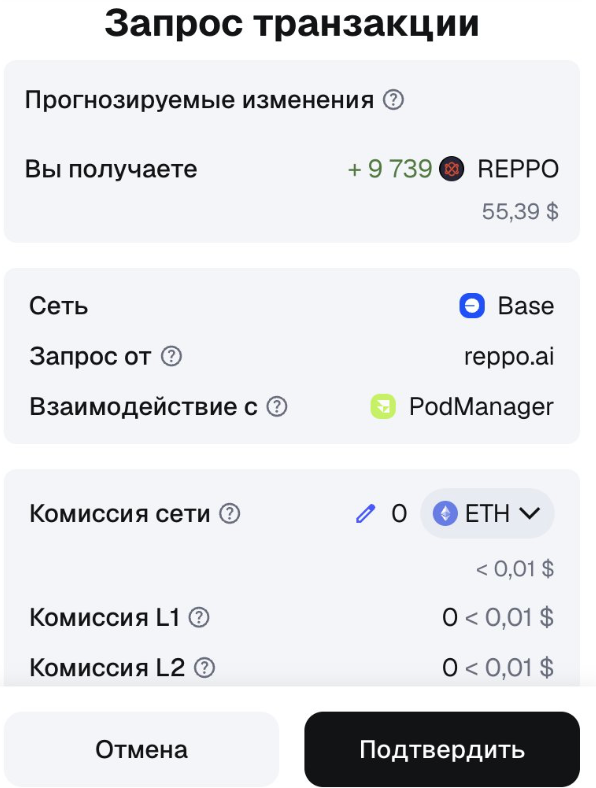
They show a smart contract and the actual payouts I received because my pods (publications) were voted for in the Reppo network. No promises. No motivational talk. No impressive graphs. Just facts.
This does not make me an authority on everything.
It simply establishes that I had real, measurable success, and therefore I can responsibly make some observations about what works and why.
I start this way because Reppo, like any new system, already attracts speculation and noise. People discuss token price without having any economic trace, any value flow, or any understanding of who pays whom, and for what.
What follows is not theory. It is a practical interpretation of how the system actually behaves.
My practical experience: what was rewarded and how much
I received solid rewards for published projects as a software engineer.
I built:
- a Telegram bot for "joined" spam cleaning,
- a Discord bot for analyzing web3 scam patterns, which are extremely common in web3 projects and Discord guilds.
Some pods, including my Discord bot, received more than 33% of the publisher reward pool in certain epochs. With a maximum publisher allocation of 25,000 tokens, I received up to 9,000 tokens per epoch.These were stable, non-trivial rewards. This leads to the only question that matters:
Where do these rewards come from, and why can they be earned at all?
Voting as an economic mechanism, not a “like”
The source of rewards in Reppo is not developer support or protocol generosity.
It is a prediction-market–based voting mechanism, embedded in a broader economic model.
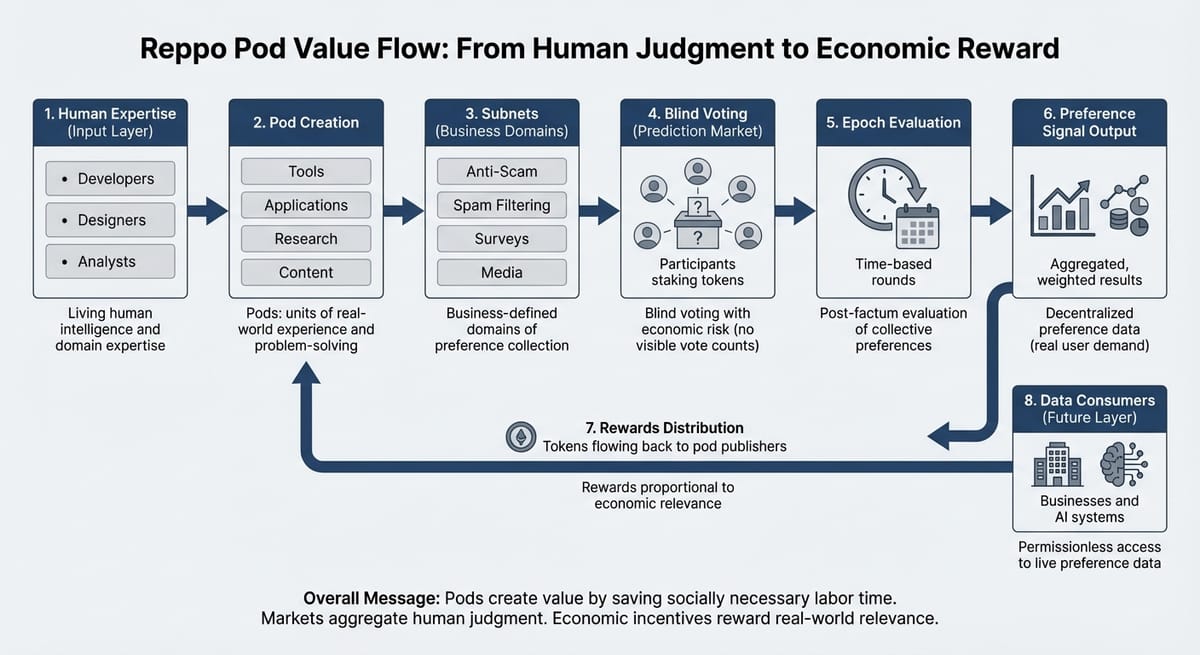
Each Reppo subnet emits 50,000 tokens per epoch. This emission should not be understood as “free money.” Economically, it functions as a form of credit money — not in a legal sense, but in an economic one — tokens issued in advance under the assumption that future consumers of data will be willing to pay for access to preference signals generated by the network.
Participants in Reppo voting put economic stake at risk. That stake determines the weight of their vote and enables selection between pods. Voting is conducted blind: participants do not know how many votes any pod has received during the epoch. Results are revealed only after the epoch ends.
This blindness is not cosmetic. It creates the technical condition to collect real user preferences, not declared opinions or social signals. Each epoch becomes a time-bounded snapshot of collective preference, expressed under economic risk rather than symbolic approval.
Importantly, this system is already partially demand-backed. Alongside individual voters, businesses participate in prediction markets by acquiring tokens from the open market, thereby directly funding rewards in each epoch. In this way, demand for tokens is already being formed today — not hypothetically, but through concrete business participation.
Looking forward, this demand is expected to expand further. Reppo plans to introduce Reppo Exchange, built on top of Anoma Intents, where the intention to obtain preference data becomes directly executable through the Reppo protocol. Data consumers will not merely speculate on future value — they will express explicit intent to acquire data, routed and settled permissionlessly.
In this sense, a pod is not a post, not a bot, and not an application by itself.
A pod is a unit of experience, exposed to a preference market, financed through credit-like emission, partially demand-backed in the present, and evaluated post-factum by economically weighted human judgment.
Reppo’s protocol model: why this goes beyond crypto
Reppo is structurally asymmetric, and this is its core strength.
On one side, the protocol allows businesses to create subnets that collect preference data in specific domains. Today, we already see subnets for phishing emails, surveys, and yes—even pornography. This is not a flaw. It demonstrates that the protocol does not impose moral or corporate filters on what can be studied.
On the other side, Reppo is designed for future data consumers. The protocol aims to allow permissionless access—not only to initiate new preference collection, but to connect to already accumulated, up-to-date preference data in a given business domain.
Reppo is not just a voting infrastructure.
It aims to be a permissionless protocol for accessing live consumer preference data.
This ambition goes far beyond crypto and even beyond software engineering. It addresses a fundamentally economic problem: how to collect reliable information about what people actually want, in real time.
The twentieth century already offers an example of a system that failed at this task. The Soviet Union was unable to solve the problem of rapidly collecting and processing real preference data from production and everyday life, and the consequences are well known. That discussion deserves its own articles — or books, strictly speaking.
For now, what matters is this:
Pods are valuable because they participate in solving this problem.
Why humans still matter in the development of AI
Each business domain defines value differently. There is no universal scale and no abstract metric that can be applied across contexts.
The decisive factor remains the living human mind participating in voting. Humans evaluate whether a pod is connected to reality — whether it reflects actual practice, concrete conditions, tacit knowledge, and changing circumstances. This type of judgment cannot be reduced to formal signals or statistical correlations.
Artificial intelligence has no sensory organs, no social embeddedness, and no independent access to the complexity of the real world. It does not participate in production, consumption, or conflict. That role still belongs to humans and will continue to belong to them as long as human society exists.
At the same time, economically grounded preference data is precisely what allows AI systems to improve. Models can be refined, corrected, and aligned using these signals. This process has no terminal state: as society changes, preferences change, and the signal must be continuously regenerated.
Reppo creates economic incentives for the continuous development of AI, grounded not in static datasets, but in living, constantly updated human experience.
This also opens a far more radical possibility: the collective, decentralized development of the means of production. Within Reppo, participants do not merely contribute data — they contribute labor, judgment, and expertise, and receive remuneration for it. Each participant is compensated for their role in producing economically valuable signals.
This stands in sharp contrast to the dominant model today. Contemporary AI systems are trained on vast amounts of user-generated data that is effectively appropriated for free by large corporations such as X, YouTube, and Google. Users generate value, but receive no direct compensation for their contribution to model improvement.
Prediction markets change this logic. Small and medium businesses, independent developers, researchers, and other actors interested in building real software products can coordinate within a single economic ecosystem. Instead of isolated commodity producers, they form a cooperative network in which preference data, tooling, and intelligence are jointly produced, evaluated, and rewarded.
In this sense, Reppo is not merely an AI-adjacent protocol.
It is an experiment in organizing digital labor and knowledge production as a shared economic process, where value is measured, selected, and distributed through market mechanisms rather than extracted unilaterally.
A strict definition: what makes an AI generated content valuable
From this, a precise definition follows.
A valuable Reppo pod is a pod into which living human effort is invested.
Its value is measured by the amount of socially necessary labor time it saves.
In other words, a pod must optimize a real production task and reduce the time required to solve it.
- If you publish an application—even a vibe-coded one—you must verify that it solves a real, practical problem. It must save time or money. Money is simply an expression of socially necessary labor time.
- If you publish an article or analysis, it must reduce someone’s time to understand, decide, or act. Otherwise, it is noise.
In entertainment, the logic is different — but it is not absent.
Videos, films, music, and fiction must be alive: interesting, novel, and engaging. But this liveliness is not an abstract aesthetic requirement. It has a concrete economic dimension.
The production of consumer goods has always included the production of leisure and cultural consumption. Content created for leisure is not outside the economy; it is a commodity that is produced, distributed, consumed, and sold. As such, it is also subject to constraints of time, attention, and resources.
In modern conditions, the key scarce resource is time. Leisure content competes directly for limited human attention, and poor-quality or poorly targeted content wastes that time. From this perspective, user preferences regarding formats, genres, pacing, and modes of presentation acquire real economic significance.
Preference data in entertainment domains therefore has value because it helps optimize the production and consumption of leisure:
- it reduces the time required for users to find relevant content,
- it reduces production waste by aligning output with actual demand,
- it lowers the cost of experimentation by signaling what resonates and what does not.
In this sense, even entertainment content participates in the same underlying logic as tools or applications. It either economizes time and resources — for both producers and consumers — or it contributes to noise and inefficiency.
That is why preference signals in leisure and media domains matter. Content for leisure is not merely expression; it is socially produced consumption, and its alignment with real human preferences determines whether it has value or not.
Practical criteria for profitable Reppo pods
A profitable pod typically satisfies the following:
- Clear connection to a real process
- Measurable reduction of labor, cost, or cognitive load
- Human judgment in the loop
- A clear economic addressee (who benefits and why)
- Value reproducible across epochs, not a one-off result
Final advice
And now, the most important principle.
You are the niche.
You already have a set of competencies you are good at. If you are a developer, a designer, an analyst—there is a place for your skills in almost any subnet.
Think in terms of business value.
Identify a real problem. Solve it.
Create a working solution.
Build a demo.
Present it clearly.
Add a diagram.
Show how it connects to reality.
Publish it.
Let the market do the rest.
Publish. Predict. Earn.